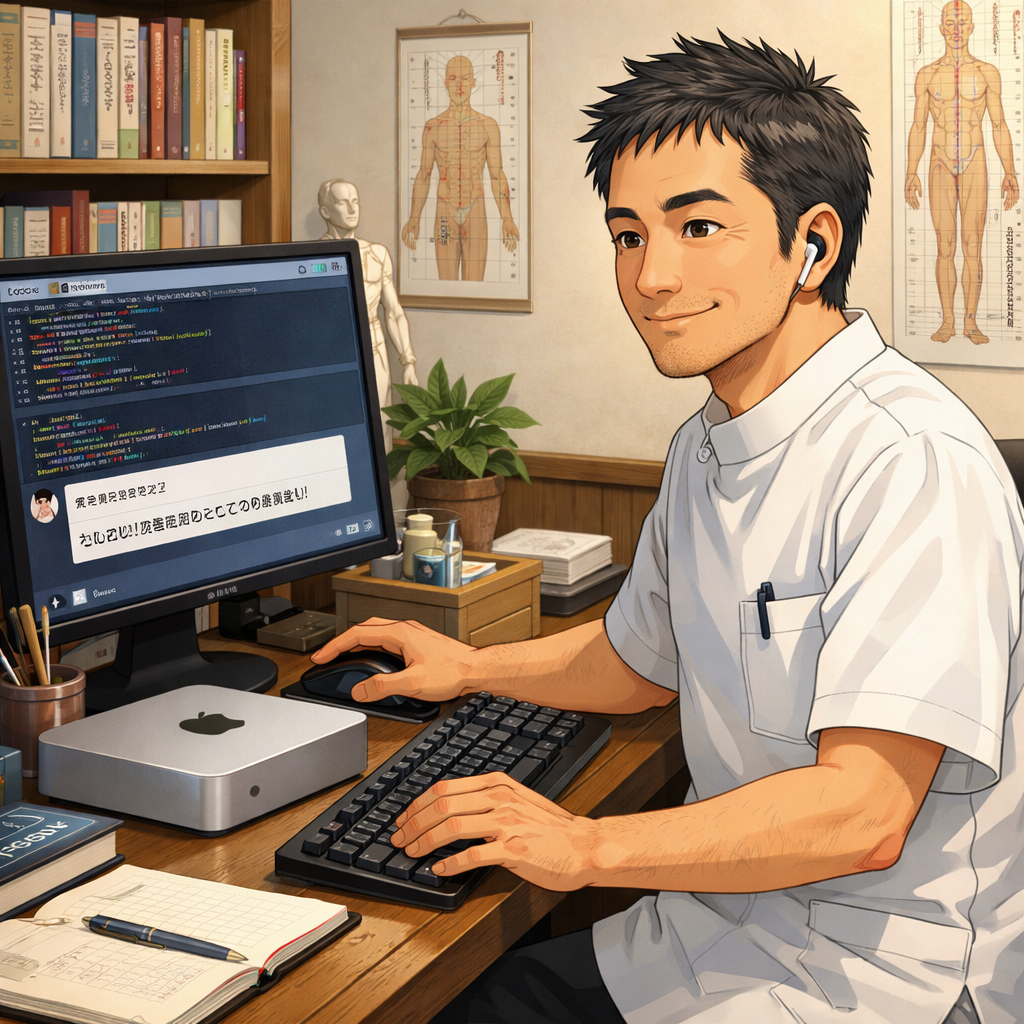
先日、訪問マッサージに勤めて2か月ほどになる方から相談を受けた。親指な腱鞘炎になって、指の痛みがなかなか取れないとのことだった。ちょうど太極拳の先生と一緒に実際の揉み方を見たところ、親指に負担がかかるような揉み方をしていることがわかった。いわゆる指揉み。
また女性で手が細いこともあり、同じようにはできないと思ったので、いろいろ工夫できることを先生と二人で実際に手の使い方や身体の使い方を見ながら考えてみた。
一番の問題は、まだ身体ができていない、姿勢と動きの問題だ。
訪問マッサージは相手の家が施術室になるので、環境が治療院とは大きく異なる。ベッドか布団かも相手の環境次第で、仰臥位・側臥位・座位とあるため、それぞれに合わせたマッサージ法をひとまず覚えておかなければならない。
動きは下半身・丹田あたりの運動が基本となる。理想は肩の力が抜け、前腕と手首を上手に連動させていくことだ。
手が細い人は親指を多用せず、人差し指や中指の第二関節、あるいは母指球を「指」として活用していくことだ。親指だけを酷使せず、膝や肘も指と同様の使い方をするのがよい。
実際には、揉むことも押すことも手で行っているようでいて、手だけで行っているわけではない。
むしろ丹田や腰、足の使い方の方が重要かもしれない。按摩指圧は布団やマットが昔は基本だったので、丹田の意識や腕と膝の連動方法と深く結びついている。
今はベッドでの施術が普通になっているが、太極拳などのゆったりした身体の使い方を学ぶことは大切だと思う。後ろ足が浮けば圧は浅くなり、肩に力が入れば術者が先に疲れる。
頸部の把握でも同じで、指をどう動かすかより、どこを固定し、どこを自由にするかが大切になる。
頸部は繊細な部位なので、親指を効かせるより四指を上手く使った方が安全で、柔らかい感触になることも多い。
また訪問では側臥位で施術する場面が多い。筋肉を直接押し込むより、肢位や角度を少し変えるだけで、隠れていた硬結が現れることがある。その筋肉の隙間のようなものを見つけられると、効率よく力を伝えられる。
最初は仕方ないが、慣れてくると手や指の意識を消して自動運転できるようにしていく。
もう一つ大事なのは患者さんとの対話だ。触っている側は分かったつもりになりやすいが、実際に何が起きているかは本人にしか分からない部分もある。痛みなのか、心地よさなのか、奥で何かが変化している感覚なのか。身体を観察しながら言葉を拾っていく作業。
聞き方も相手にコイツ素人か?などの不安を与えないように相手の言葉の傾向を考えて試すのがいい。最初の3年くらいはいろいろ試した気がする。
無口な人は筋肉の反応や顔の表情を観察する。昔は唇の動きも観察しようと思ったことがあった。
痛みの質を聞いてとりあえず筋肉の状態と相手の感想を無意識に放り込んでおけと最初に師匠に言われたのを思い出した。そのうち触っただけで推測できるようになると。確かにそうだと思える。
結局のところ、学校での技術習得は手順を覚えることでいっぱいになるが、問題はその先だ。
• 身体の使い方を学び、
• 相手の身体を観察し、
• 反応を確かめ続けること
をロールプレイで学び、現場でトライアンドエラーしながらデータを積み上げていくことが大切となる。
学校を卒業すると技術は現場の中で育っていく。
触って、聞いて、考えて、また試す。
結局はその繰り返しなのだと思う。
Recently, I was consulted by someone who has been working in home-visit massage for about two months. She said she developed tendinitis in her thumb and the pain in her fingers wouldn’t go away. When I happened to look at her actual massaging technique together with a Tai Chi master, we found that she was massaging in a way that put a strain on her thumb. A so-called “finger-massaging” technique.
Furthermore, since she is a woman with slender hands, I thought she wouldn’t be able to do it the same way as we do. So, the master and I looked at how she actually used her hands and body, trying to think of various adjustments she could make.
The main problem is that her body is not yet conditioned for the work—it is an issue of posture and movement.
In home-visit massage, the patient’s house becomes the treatment room, so the environment is vastly different from a clinic. Whether it is a bed or a futon depends on the patient’s setup, and you have to work with supine, lateral, and sitting positions. Therefore, you must first memorize the massage methods suited to each.
Movement fundamentally relies on the lower body and the Dantian area. The ideal is to release tension from the shoulders and skillfully coordinate the forearms and wrists.
People with slender hands should avoid overusing their thumbs and instead utilize the second knuckles of their index or middle fingers, or the thenar eminence (the base of the thumb), as if they were “fingers.” Instead of overworking only the thumb, it is better to use the knees and elbows in the same way as fingers.
In reality, though it seems like kneading and pressing are done with the hands, they are not done with the hands alone. Rather, the use of the Dantian, hips, and feet might be more important. In the past, Anma and Shiatsu were fundamentally performed on futons or mats, which is deeply connected to the awareness of the Dantian and the coordination between the arms and knees.
Nowadays, treating on a bed has become standard, but I think it is crucial to learn the relaxed way of using the body found in disciplines like Tai Chi. If the back foot lifts, the pressure becomes shallow; if you tense your shoulders, the practitioner will tire out first.
The same applies to palpating and gripping the neck. Rather than how to move your fingers, what matters is where to fix and where to leave free. The neck is a delicate area, so rather than forcing the thumb to work, using the other four fingers skillfully is often safer and provides a softer touch.
Also, in home visits, you often treat patients in a lateral position. Instead of pressing directly into the muscle, simply changing the limb’s position or angle slightly can reveal hidden indurations (knots). If you can find these gaps between the muscles, you can transmit your force efficiently.
It cannot be helped at first, but as you get used to it, you should erase the consciousness of your hands and fingers and let them operate on autopilot.
Another crucial point is dialogue with the patient. The person touching easily falls into the trap of thinking they understand everything, but there are parts of what is actually happening that only the patient can know. Is it pain, comfort, or a sensation that something is changing deep inside? It is a process of gathering words while observing the body.
As for how to ask questions, it is best to consider the patient’s verbal tendencies and test different approaches so as not to cause anxiety or make them wonder, “Is this person an amateur?” I feel like I spent about the first three years trying out various ways.
For quiet people, observe their muscle responses and facial expressions. In the past, I even thought about observing the movement of their lips.
I remembered my master telling me at the very beginning, “For now, ask about the quality of the pain, and subconsciously throw both the muscle condition and the patient’s impressions into your mind. Eventually, you’ll be able to deduce it just by touching.” I can certainly see now that he was right.
In the end, learning techniques at school fills your head just with memorizing procedures, but the problem lies beyond that.
• Learning how to use the body,
• Observing the patient’s body,
• Continuously verifying the responses.
It is essential to learn these through role-playing and accumulate data through trial and error in the field.
After graduation, your technique grows within the clinical field.
Touch, listen, think, and try again.
In the end, I believe it is simply the repetition of this cycle.