学生時代から体力だけはあったが、マッサージをしていると疲労感が長く残った。単に身体の使い方が悪いだけではないようにも感じていた。
これは鍼灸も全くそうだ。どちらかというと鍼の方が疲労感が強くなるので手技が多くなった気がする。
鍼より手技の方が効果が出せた。鍼が下手くそという意味でもある。
同級生や先輩からは、「気は減ることがあるらしい」と聞かされた。ちょうど気功ブームが始まった時期でもあり、そんな話題になった記憶がある。
二年生の頃には、西野呼吸法が一世を風靡していた。西野皓三先生が何人もの人を触れずに派手に投げるものだから、テレビで放映され雑誌でも話題になっていた。
疲労感はシャレにならず、仕事にずいぶん影響した。学生時代に2度ほど仕事を辞めた。
この対策も課題となった。
少し収まったのは、友人が「気はトレーニングで溜まるらしいよ」という話を持ってきてからだった。
ちょうどその頃、医療関係者を対象にした一指禅功という仏教系の気功講座が始まり、参加してみた。
教室では四十分から五十分ほど立ち続ける。「立っているだけで気が溜まる?」怪しい話に騙されているのではないかと思ったものだ。
ときどき先生の実演を受けると、自分の意思とは別に身体が反応することがあり、「少なくとも、ただ立っているだけではなさそうだ」と思い直した。
気そのものを、目に見える形で示してくれたのはこの先生である。参加者全員が声を上げたものだ。
宿題も、朝一時間、夜一時間、ひたすら立ち続ける気功法だった。それでも三か月ほどすると、以前ほど疲れなくなり、元気になったように感じた。気感も強くなった。
一時期は面白くなり、いくつかの気功法を学んだ。手の感知能力を高めることも急務だと思っていたが、こちらはなかなか簡単にはいかなかった。
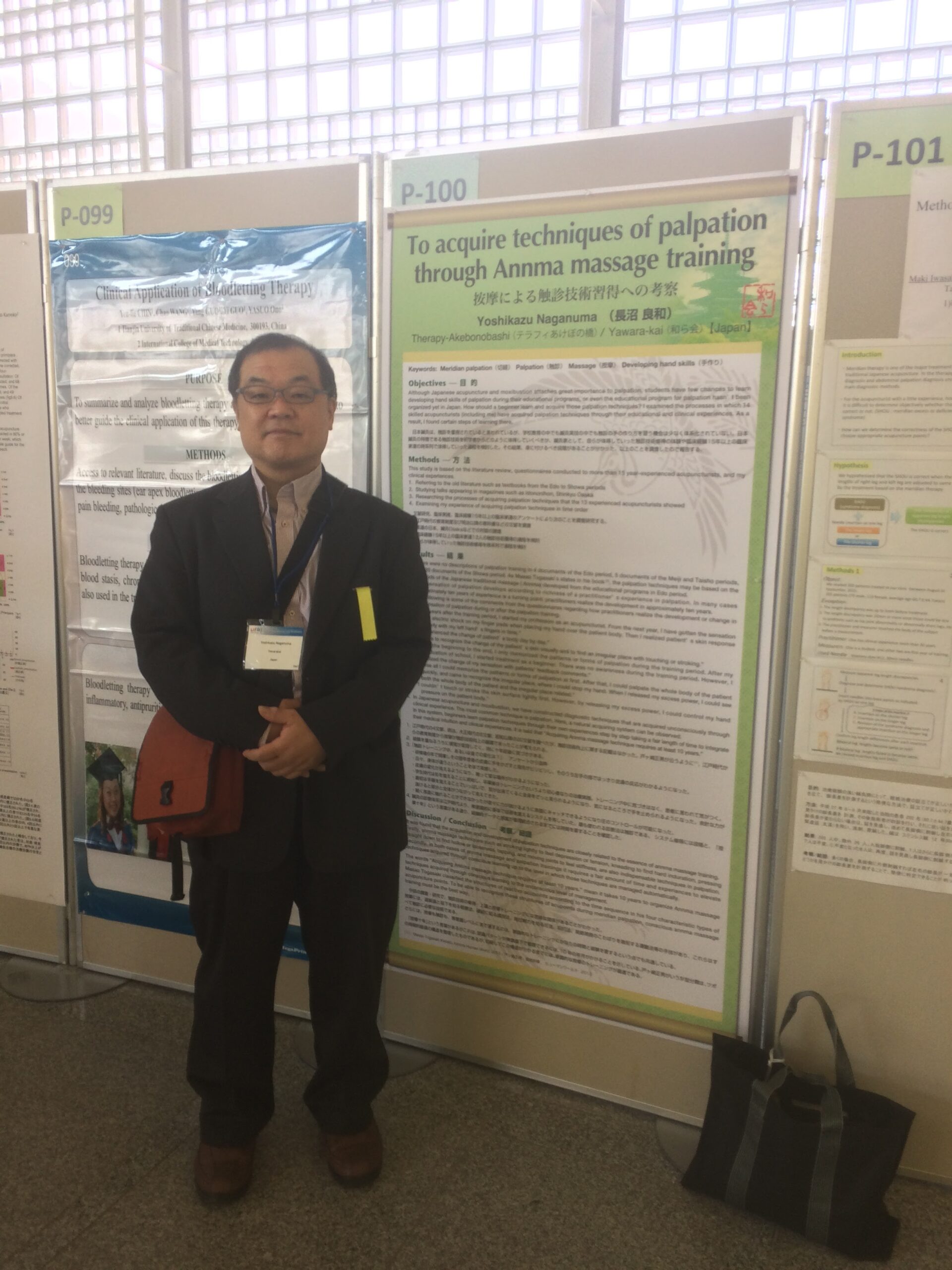
脈診も習ったが、あれほど狭い幅の拍動の中に、身体全体の情報を示すサインがあるとは、当時の私にはなかなか思えなかった。そこで、別の診断法をつくる方向へ進んだ。触診だ。触ってわかれば越したことはない。按摩指圧にも直結している。
意識の使い方が上手な同級生も何人かいた。自分も技術と並行して身につけられればよいと思ったが、そうは問屋が卸さない。
三年ほどウロウロして、やはり触診は難しいと感じていた頃、習っていた二人の先生から、「指圧をやっている人に教えるのは難しいのかな」と言われた。半ば諦めかけていた。
それでもある日突然その日がやってきた。
いきなりジャンプするように感じられて、こちらの方が驚いた。
分からないから押して「探す」という意識から、諦めて手を置いたり摩って「感じる」「聴く」という意識に切り替わった時だった。
後に、脈診は生命交流だと言われる先生が3人おられた。
自分の身体に違和感や痛み、イメージが立ち上がるのが大事だと言われたが、私はそこまでは習得できなかった。そもそも、そうした感覚を長期的に訓練できる環境でもなかったと言い訳をしてみる。
診断法は現在の環境と合わせて試してみてイケると感じるものを組み直してもよいのではないかと思うようになった。
同級生の一人も一年ほど脈診をして「こりゃ自分には無理だわ」と感じて筋肉診断に移り成功している。
望診・聞診・問診・切診とあるが、何となく引っかかるという「虫の知らせ」のような身体感覚も加えバランスよく利用している。現場では適応外という人が必ずいる。こういうのを見分けるのは診断である。
最近、約百二十年前に流行した動物磁気療法の本を読んだ。
そこでは、施術を生命エネルギーの「輸血」のように表現していた。
序文から注意事項があり、読み進めると施術者が疲労し、薬物を使用し、場合によっては病に至る例まで挙げられている。
もちろん、当時の生命観や医学観をそのまま現代に持ち込むことはできない。それでも、施術者の消耗という問題が昔から観察されていたことは興味深い。
卒業してから五年ほどは、臨床の成否を分けるものは、体質と手技の選択、ツボの選び方、虚実の判断だと思っていた。
もちろん、それらは現在でも重要である。
ただ、どうもそれだけではないと、当時からぼんやり感じていた。
相手との「つながり感」も、その一つかもしれない。
以前、五十人ほどが参加するワークショップで、二人一組になり、一人が横になり、もう一人がその人との間で心地よく感じられる場所を探すということを行った。
まるで昔読んだカルロス・カスタネダの「ドン・ファンの教え」の一シーンが再現された。
参加者が歩き回っている中でも、組になった相手との間には、見えないコードのようなつながりが感じられた。心地よさとともに、関係が安定するような主観的感覚があった。
これを客観的な現象としてすぐに説明することはできないが、臨床において無視できない経験の一つではある。
術者自身の意識のあり方も、重要な問題である。
完全に同じ意味ではないが、古典風に言えば「治神」、現代風に言えば「ニュートラルになる」「グランディング」「メタポジション」。私の師匠は「天と地と繋がる」と表現している。
トレーニングで静かな落ち着いた状況を作ることだ。大袈裟に言えば仕事中は瞑想状態といえる。
会話はできないかと言えばそうでもない。パフォーマンスを発揮できる意識状態だ。
ベテラン期に入った職人、スポーツ選手やダンサー、役者はこういう感覚が分かるのではないか?
以前の私は、施術における「エネルギーの質」を決めるのは、術者自身の生命力の旺盛さではないかと考えていた。
友人のオステオパシーの一形態であるバイオダイナミクスを体験して考えが変わった。
按摩や指圧では、自分なりに作為を消してきたつもりだった。それでも、バイオダイナミクスを受けた時には、「ここまで術者の存在を消すのか」と驚いた。
相手の生命力をいかに引き出すか。
引き出すトリガーのための環境を整えることが大切だという考え方に立てば、余計な介入はしないということになる。
サポートに徹して相手の動きが出やすい環境を整える。
私が効果を感じた経絡治療の先生方にも、強く働きかけるというより、相手の反応が出やすい条件を整えているように感じることがあった。
何かを送り込むことよりも、相手の身体に起きている働きを邪魔せず、待ち、聴き続ける。動き始めたらサポートをする。
そこでは、術者の能力や生命力の強さよりも、術者がどのような状態でその場にいるかが重要になる。
技法の背後には、術者の内的な「在り方」がある。
皮膚に灸痕を残す有痕灸から、温熱刺激を調整する方法、施術者の呼吸や意識の置き方を重視する方法まで幅がある。
気についての表現も、プラーナ・オーラ・エーテル体・後光・バイオフォトンなど様々な言い方があり、これらはすべて同じものではなく、それぞれが異なる文脈から生命の働きを説明しようとした言葉なのだろう。
AIと壁打ちしていたら、「生命の設計図のようなものがあり、その状態を保つ働きがホメオスタシスではないか」という表現が出てきた。生理学的にはかなり粗い比喩だが、生命体が物質の集合以上の秩序を保っているという意味では、考えるきっかけになった。
人は死ねば、身体を形づくっていた物質は残るが、生きている間に身体の秩序を保っていた働きは失われる。
施術者の手が触れているのは、皮膚や筋肉だけではない。
身体を一つの生命体として成立させている、変化と調整の働きにも触れているのかもしれない。
まだ考えている途中である。
From my student days, I had physical stamina, but after giving massages, fatigue would linger for a long time. It didn’t seem to be simply a matter of poor body mechanics. The same was true of acupuncture — if anything, needling left me more drained, which may be why I gravitated toward manual techniques. I was more effective with hands-on work, which also means I was not particularly skilled with needles.
Classmates and seniors told me that qi could be depleted. It was around the time the qigong boom was beginning, and I remember the topic coming up often.
In my second year, Nishino Breathing Method was sweeping the country. Master Kozo Nishino was throwing people dramatically without touching them, and the footage was all over television and magazines.
The fatigue was no joke and affected my work considerably. During my student years, I quit jobs twice. Finding a solution became an urgent matter.
Things began to settle when a friend brought me the idea that qi could be built up through training.
Around that time, a Buddhist qigong course called Yizhichan Gong opened for healthcare practitioners, and I joined. In the class, you simply stood for forty to fifty minutes. “Standing builds qi?” I thought I was being taken in by nonsense.
But occasionally the teacher would demonstrate on me, and my body would respond in ways outside my own volition. I reconsidered: “This is at least not just standing around.” That teacher was the first person to show me qi in a visible form. Every participant in the room reacted.
The homework was relentless: stand for one hour each morning, one hour each evening. Even so, after about three months I noticed I was no longer as exhausted, and my energy felt restored. My qi sensitivity also sharpened.
For a period I became genuinely interested and studied several qigong methods. I also considered it urgent to develop my hands’ perceptual ability, though that proved far more difficult.
I studied pulse diagnosis as well, but I could not quite accept, at that stage, that the narrow band of a pulse could contain signs reflecting the entire body. So I moved in another direction — palpatory diagnosis. If I could understand through touch, all the better. This connected directly to anma and shiatsu.
Some classmates were naturally adept at working with intention. I hoped to cultivate that alongside technique, but it did not come easily.
After wandering for about three years, feeling that palpatory diagnosis was genuinely difficult, two of my teachers remarked — half in resignation — that it might simply be hard to teach people who practice shiatsu.
Then one day it arrived without warning. It was like a sudden leap, and I was the one who was surprised.
The shift was from pressing and searching because I did not understand, to placing my hands and feeling, listening — an acceptance, a letting go of effort.
Later, I met three teachers who described pulse diagnosis as a life exchange. They said it was important for one’s own body to register discomfort, pain, or arising images. I was not able to reach that level. Partly, I tell myself, because I was not in an environment that allowed for long-term training of those sensibilities.
I have come to think that diagnostic methods may legitimately be reconstructed — selecting and combining what one has tested in one’s actual context and found to work.
One classmate practiced pulse diagnosis for about a year, concluded it was not for him, shifted to muscular diagnosis, and succeeded with that.
Inspection, listening, inquiry, and palpation are the classical four methods — but I also use what might be called bodily intuition, an unclear sense that something is amiss, alongside the others. In clinical practice there are always people who fall outside standard approaches. Identifying them is a matter of diagnosis.
Recently I read a book on animal magnetism therapy that flourished about one hundred and twenty years ago. It described treatment as something like a “transfusion” of life energy.
From the preface onward, cautions were noted: practitioners became fatigued, required medicines, and in some cases fell ill. Of course, the conceptions of life and medicine from that era cannot be imported wholesale into the present. Even so, I found it striking that the depletion of the practitioner was being observed and recorded so long ago.
For about five years after graduation, I believed that what determined clinical success was constitution, the choice of technique, point selection, and the assessment of excess and deficiency.
Those factors remain important today.
Yet even at the time, I had a vague sense that they were not the whole story.
A feeling of connection with the patient may be part of it as well.
Some years ago, at a workshop of about fifty people, pairs were formed: one person lay down, and the other moved around trying to find the position that felt most comfortable in relation to them.
It was like a scene from The Teachings of Don Juan by Carlos Castaneda, which I had read long before.
Even as participants moved about the room, I could sense something like an invisible cord connecting me to my partner. There was a quality of ease, and a subjective sense that the relationship was settling into stability.
I cannot readily explain this as an objective phenomenon, but it is one of those clinical experiences I cannot set aside.
The state of the practitioner’s own consciousness is also a significant matter.
Not identical in meaning, but rendered in various registers: the classical term zhi shen (“governing the spirit”), or in contemporary language, “becoming neutral,” “grounding,” “meta-position.” My teacher expresses it as “connecting with heaven and earth.”
The aim, through training, is to arrive at a quiet, settled condition. In a somewhat grand formulation, the working state during treatment might be called meditative. That does not mean conversation is impossible — it is simply a state of consciousness in which performance is fully available. Experienced craftspeople, athletes, dancers, and actors may recognize this.
I used to believe that what determined the quality of energy in treatment was the vitality of the practitioner.
An experience with biodynamic osteopathy — a form of osteopathy practiced by a friend — changed my thinking.
In my anma and shiatsu work, I believed I had been reducing my own intervention as much as I could. But receiving biodynamic treatment, I was struck by the thought: “Is it possible to efface the practitioner’s presence this completely?”
How to draw out the patient’s own vitality. If the aim is to prepare the conditions that trigger its emergence, then unnecessary intervention becomes something to eliminate.
Stay in support; prepare an environment in which the patient’s own movement can arise. Among the teachers of meridian therapy whose work I found most effective, I sometimes sensed not a strong imposition of force, but a careful arrangement of conditions from which the patient’s response could emerge.
Rather than sending something in — not obstructing what is already happening in the patient’s body, waiting, listening continuously. When movement begins, offer support.
In that frame, what matters is not the strength or vitality of the practitioner, but what state the practitioner inhabits in that space.
Behind every technique is the practitioner’s inner way of being.
The range is wide: from moxa that leaves marks on the skin, to methods that modulate thermal stimulation, to approaches that emphasize the practitioner’s breathing and the placement of attention.
Expressions for qi are many — prana, aura, etheric body, halo, biophotons — and these are not all the same thing. Each is a word that emerged from a different context, attempting to describe the workings of life.
In a conversation with an AI, the expression arose: “Perhaps homeostasis is something like a blueprint for life — a function that preserves the state of the design.” Physiologically, this is a rather rough metaphor, but in the sense that a living body maintains an order beyond the mere sum of its material components, it gave me something to think with.
When a person dies, the matter that composed the body remains — but the function that maintained the body’s order while alive is gone.
What the practitioner’s hands touch is not only skin and muscle. They may also be in contact with the workings of change and adjustment that sustain the body as a living whole.
I am still thinking this through.